An Event-Driven Rotation Calendar for Memory Thematic ETFs in 2H 2026
If 2025 was the year investors “discovered” memory as the hidden backbone of AI, then 2026 is the year that discovery turned into a full-blown rotation. Capital has been shifting from GPU-only stories into the broader AI storage and computing power stack, with memory chip ETFs quietly delivering triple-digit returns and outpacing headline semiconductor benchmarks. Against that backdrop, thinking about a second-half rotation calendar for “memory theoretical ETFs” is not just a thought experiment — it is a way to structure how you move through the cycle as key events arrive.
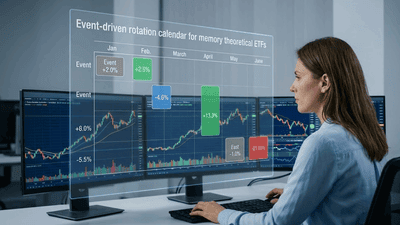
This post sketches an event driven rotation calendar for 2H 2026, built around hypothetical yet plausible memory-focused ETFs and index derivatives tied to AI infrastructure. The tone will be intentionally varied: part practical, part narrative, part speculative, because markets themselves are rarely monotone. The goal is not to dictate trades, but to suggest how one might choreograph rotations across different memory exposures as data points, price cycles and AI deployment milestones unfold.
The Cast: Theoretical Memory ETFs As Cycle Characters
To make the calendar concrete, imagine a suite of theoretical ETFs, each capturing a different slice of the memory and AI storage ecosystem:
- Core DRAM & HBM ETF (“DRAM-Core”): Concentrated holdings in major DRAM and high bandwidth memory manufacturers — the names at the heart of AI data center bottlenecks.
- NAND & Storage ETF (“NAND-Storage”): Focused on SSDs, flash memory, and data center storage systems, including controller designers and enterprise storage vendors.
- AI Data Center Memory ETF (“AI-MemInfra”): A blend of memory producers, module assemblers, and hyperscaler-oriented hardware providers tied directly to AI server configurations.
- Balanced Memory Cycle ETF (“Cycle-Balance”): A more diversified mix across DRAM, NAND, emerging persistent memory and storage-class memory suppliers.
These theoretical ETFs can be overlaid with index derivatives — futures, options, swaps — that allow more tactical rotations without fully rebalancing spot holdings. With this cast in mind, we can start imagining a calendar for 2H 2026.
Macro Backdrop For 2H 2026: Scarcity, Price Ramps, Capex Surges
Second-half 2026 is not a neutral landscape. Several structural trends are already in motion:
- Global memory prices are rising sharply, with DRAM and NAND contract prices climbing quarter-on-quarter and industry revenues projected to approach or exceed $1 trillion in 2026.
- AI data center capex is set to accelerate further in 2H 2026, driven by the ramp of next-generation accelerator platforms and continued expansion of AI-centric server deployments.
- The AI memory shortage that began in 2025 has entered its second year, with high bandwidth memory (HBM) and server-grade DRAM remaining structurally tight.
This backdrop matters because it shapes the seasonal rhythm: the second half is defined by price ramps, capacity announcements, product refresh cycles and periodic debates about “demand destruction” in the consumer segment versus persistent strength in AI infrastructure. An event driven rotation calendar stitches these threads into a sequence of potential shifts between our theoretical ETFs.
July–August 2026: Earnings Season And Price Confirmation
The third quarter typically begins with a wave of earnings reports from major memory and AI infrastructure companies. In 2H 2026, those reports will be colored by record monthly memory sales, price hikes and the early impact of pulled-forward capex.
In an event-driven rotation framework:
- Pre-earnings positioning: Investors might lean into DRAM-Core and AI-MemInfra ahead of reports, expecting positive surprise on margins and guidance linked to structurally undersupplied DRAM and HBM markets.
- Post-earnings reaction: If results confirm higher ASPs and tight supply but also flag emerging consumer weakness, rotation could tilt toward AI-MemInfra and Cycle-Balance, reducing pure-play consumer NAND exposure in NAND-Storage.
- Options overlays: Index options on DRAM-Core might be used for earnings-straddle strategies, with traders betting on volatility around guidance revisions.
The calendar here is less about specific dates than about the window: the weeks when earnings concentrate and narrative shifts crystallize. A flexible investor might plan to review allocations in mid-July and early August, explicitly deciding whether to lean into or away from high-volatility memory segments based on the character of the cycle.
September 2026: Contract Price Resets And Procurement Windows
Memory markets often feature periodic contract resets and procurement windows, especially for server DRAM and enterprise storage. In 2026, analysts are already flagging major contract price increases for DRAM and NAND into the second and third quarters, with some debate about whether consumer demand will eventually be squeezed.
An event driven rotation calendar in September might look like:
- Supply-side signals: As new contract pricing data arrives, investors reassess which memory segments will bear the brunt of price increases and where demand may bend. Structural undersupply in server DRAM could favor DRAM-Core and AI-MemInfra.
- Consumer segmentation: If evidence of consumer demand destruction emerges, a rotation away from consumer-heavy NAND and toward data center storage names in NAND-Storage might make sense.
- Index derivatives: Futures on a broad memory index could be tilted long to capture price-led revenue expansion, while options help hedge against sharper-than-expected consumer slowdowns.
September becomes a hinge month: a time when price data and procurement behavior either reinforce the “scarcity plus pricing power” narrative or introduce a more cautious tone. A rotation calendar that acknowledges this hinge encourages investors to pre-plan how they’ll adjust ETF weights around these updates rather than reacting purely on instinct.
October 2026: AI Accelerator Ramps And Data Center Capex Updates
By October, attention may shift from pure memory metrics to the broader AI stack. New accelerator platforms, custom hyperscaler chips and AI server refresh cycles influence how much memory and storage capacity will be deployed in the following quarters. These events are crucial for memory demand because they set the contour of AI workloads that will consume DRAM, HBM and NAND.
An event driven rotation calendar for October might involve:
- Capex updates: As industry groups and hyperscalers update AI infrastructure capex plans, investors gauge whether the second-half ramp is accelerating or plateauing. Strong updates favor AI-MemInfra and Cycle-Balance.
- Server configuration changes: Shifts toward higher memory-per-node configurations or expanded storage-class memory deployments benefit the more specialized segments within DRAM-Core and NAND-Storage.
- Rotational nuance: If GPU-centric ETF performance begins to lag while memory and storage ETFs maintain strength, sector rotation into memory-themed products may intensify, reinforcing an earlier trend from 1H 2026.
This part of the calendar is about directional signals from AI architecture itself. When AI deployments promise more memory intensity per watt and per rack, rotation toward memory ETFs becomes not just tactical, but structural — a longer-duration shift in portfolio emphasis.
November 2026: Policy, Export Controls And Industry Conferences
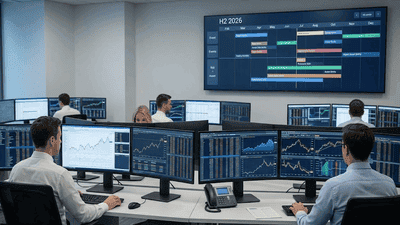
November often brings a mix of policy developments and industry conferences. In the memory and AI space, export controls, security concerns and sovereign cloud initiatives have become recurring themes. These can hit memory ETFs unevenly, depending on which companies and regions are most affected.
An event driven rotation calendar might highlight:
- Policy events: Announcements around export licensing for advanced memory or AI accelerators can prompt rotations between regionally focused memory ETFs — for instance, theoretical China-focused versus global memory baskets.
- Conference signals: Industry events where executives discuss HBM ramps, DRAM supply discipline and NAND transitions can shift sentiment about which segments are over- or under-valued.
- Derivative adjustments: Traders might rebalance index swaps or options to reduce exposure to policy-sensitive names and enhance exposure to companies benefiting from domestic or allied-sphere memory investment.
November’s calendar is less predictable than earnings or contract resets; it is more narrative-driven. The rotation logic here emphasizes flexibility: being able to pivot quickly between memory segments and geographies as policy risk and strategic initiatives reprice the landscape.
December 2026: Year-End Positioning And Forward-Looking Rotations
As the year closes, investors typically review performance, rebalance portfolios and position for the coming year. In 2026, memory-focused ETFs are likely to feature prominently in those reviews, given outsized returns and high visibility as AI bottleneck plays.
An event driven rotation calendar for December might involve:
- Profit-taking versus conviction: Investors decide whether to lock in gains in concentrated memory ETFs like DRAM-Core or roll exposure into more diversified Cycle-Balance products that can handle the next phase of the cycle.
- Forward themes: Outlook reports highlighting 2027 memory scarcity or the rise of new storage-class technologies can encourage early rotation into NAND-Storage or ETFs emphasizing SCM and persistent memory.
- Derivative rollovers: Index futures and options tied to memory and AI storage indices are rolled into new maturities, providing an opportunity to adjust strikes and notionals in light of 2H 2026’s realized volatility.
December’s calendar is where tactical events meet structural thinking. Year-end is an opportunity not just to react, but to redesign exposure: deciding how much memory to carry into 2027, where to focus within memory and how aggressively to use derivatives to fine-tune risk.
Rotation As A Calendar, Not A Formula
One of the dangers in building an event driven rotation calendar is over-precision: pretending you can map exact dates and exact moves in advance. 2H 2026 will not follow a script. Unexpected earnings surprises, new supply constraints, AI deployment shifts and policy shocks will inevitably disrupt neat timelines. The calendar is best treated as a guide, not a schedule.
To keep it flexible:
- Use events as checkpoints, not triggers. Earnings, contract resets and capex updates are times to reassess, not blindly rotate.
- Allow for overlaps. Memory pricing trends, AI architecture news and policy developments can cluster; rotations may be incremental rather than all-or-nothing.
- Preserve optionality. Derivatives — especially options — give room to express conditional views around events without fully committing to spot rotations in advance.
This way, the calendar is a rhythm rather than a rigid timetable. It reminds you when to listen closely to memory markets and AI infrastructure signals, but does not insist on a single tone or outcome.
Practical Considerations: Liquidity, Concentration, Risk Budget
Behind the elegant idea of rotating between memory theoretical ETFs lies a practical reality: liquidity, concentration risk and risk budgeting. Memory ETFs, especially those that are concentrated in a handful of large DRAM and HBM names, can move quickly and carry sharp drawdown potential despite strong structural narratives.
An event driven rotation calendar should therefore incorporate:
- Liquidity windows: Tying rotations to periods of higher trading volume — often around earnings or major news — to reduce transaction costs.
- Concentration caps: Avoiding overexposure to single names through ETF compositions, especially when one or two holdings dominate performance.
- Risk tiers: Differentiating between high-beta rotation moves (for example, leaning into DRAM-Core during price spikes) and lower-beta, diversified exposure (for example, maintaining a base in Cycle-Balance).
Embedding these constraints turns the calendar from an aspirational map into a usable plan, one that respects the realities of portfolio construction while still allowing for opportunistic moves.
Closing Thoughts: Living With A Memory Cycle In Motion
An event driven rotation calendar for memory theoretical ETFs in 2H 2026 is ultimately a way of living with a cycle in motion. Memory has become the new bottleneck for AI, and 2026’s combination of scarcity, price strength and capex surges has pulled the sector into the spotlight. But cycles never stand still, and neither should allocations.
By framing the second half of the year as a sequence of listening points — earnings, contract resets, capex updates, policy and year-end positioning — investors can give themselves a structure for rotating among different memory exposures without pretending that one shape fits all. Some will favor concentrated bets on DRAM and HBM; others will prefer balanced baskets that mix storage and emerging memory. Some will lean heavily on derivatives; others will keep rotations mostly in spot.
The essence of the calendar is not predictability, but awareness. Memory and AI storage will continue to define what is possible in computing; theoretical ETFs and index derivatives simply turn that definition into tradable paths. In 2H 2026, walking those paths with an eye on events, cycles and structural trends may be the best way to participate in the memory story without becoming trapped in a single chapter.